Why Repeating PDF Accessibility Work Is Becoming Unsustainable
Annual reports, disclosures, research papers, and compliance PDFs often follow the same layout every time they are published. Still, remediation teams end up repeating much of the same accessibility work for every document. Tags are recreated, reading order is checked again, and the same structural fixes are applied file by file, even when only the content has changed.
That workload becomes difficult to manage at scale. A 2026 large scale study on PDF accessibility across open digital repositories analyzed 100,000 PDF documents and found widespread accessibility compliance issues related to WCAG and PDF/UA requirements.
At the same time, accessibility regulations around digital documents continue to tighten. ADA Title II deadlines in the United States and the European Accessibility Act are increasing pressure on organizations to improve document accessibility workflows.
To reduce repeated remediation effort, many organizations are now introducing templatized PDF remediation into recurring document workflows. This blog explores how accessible PDF templates can help bring more consistency to PDF remediation while supporting WCAG compliance requirements.
What Is Templatized PDF Remediation? (And How Does It Work?)
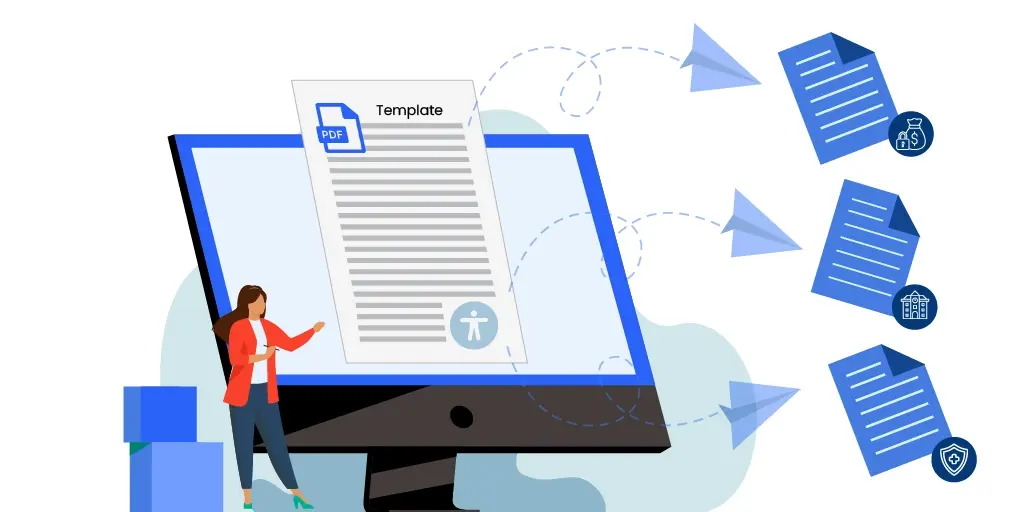
Templatized PDF remediation is the process of reusing an existing accessible PDF structure for recurring documents with the same layout, reducing the need to repeat accessibility fixes from scratch for every new version.
Most recurring business PDFs are not redesigned from scratch every time. In many organizations, recurring PDFs already follow a predefined format, with only the figures, text, or reporting period changing between versions.
Still, remediation teams frequently repeat much of the same accessibility work for every version of the document. The reading order gets checked again, tables are retagged, bookmarks are recreated, and the same structural corrections are applied repeatedly.
This approach helps reduce repeated remediation effort.
Instead of rebuilding accessibility structures for every new file, teams work from an existing accessible version of the document when the layout remains consistent.
A quarterly financial report is a good example. The numbers and commentary may change every quarter, but the document structure usually stays familiar. In those cases, remediation work becomes more about reviewing updates than rebuilding the entire accessibility structure again.
This approach is becoming more common in organizations that handle large volumes of PDFs and want more consistency in their PDF remediation process.
Which Organizations Benefit Most From Template-Based PDF Remediation?
Not every organization publishes the same type of documents. However, businesses that produce high volumes of structured and recurring PDFs often benefit the most from templatized PDF remediation workflows.
- Investment firms and asset managers: Quarterly fund reports, annual reports, factsheets, and regulatory disclosures usually follow fixed layouts with updated financial data each cycle. This makes PDF remediation for annual reports and disclosure documents more consistent and easier to manage at scale.
- Universities and research institutions: Course catalogues, prospectuses, financial statements, and recurring research publications often use standardized document structures across departments and academic years.
- Government and public sector bodies: Budget reports, consultation papers, policy documents, and compliance notices are typically published in recurring formats with predictable layouts and navigation structures.
- Healthcare, insurance, and legal sectors: These industries regularly publish standardized forms, benefit summaries, compliance documents, and disclosure materials that require ongoing accessibility support and strict WCAG compliance review.
- Large enterprises with decentralized publishing teams: Organizations where multiple departments create public facing PDFs often struggle with inconsistent accessibility practices. Standardized workflows and accessible indesign PDF templates can help improve consistency across teams.
Which PDF Document Types Cannot Be Templatized?
A template-driven remediation approach works best when documents follow a consistent structure across publishing cycles. If the layout, navigation flow, and content hierarchy remain largely predictable, organizations can reuse accessibility frameworks more effectively and reduce repetitive remediation effort.
Documents That Are Difficult to Templatize
Some PDFs rely heavily on creative design and flexible layouts, making them less suitable for reusable remediation structures.
These typically include:
- Marketing brochures where layouts change for every campaign
- Promotional materials with customized visual design
- Event collateral such as flyers, invitations, and one-time programs
- Editorial or opinion-based publications with flexible formatting
- One off white paper or bespoke client pitches
- Infographics built around unique visual storytelling
- Social media PDFs redesigned differently for each post
In these cases, manual PDF remediation is usually more reliable because accessibility decisions often depend on the unique visual structure of each document.
Key Challenges of Implementing Template-Based PDF Remediation
Although template-based remediation can improve efficiency, the process still requires careful planning, maintenance, and review. Organizations often discover that maintaining quality and compliance at scale requires ongoing oversight, structured workflows, and accessibility expertise.
1. Building the first template requires significant expertise
Creating an accessible master template takes careful planning, testing, and validation. A poorly structured template can introduce the same accessibility issue into hundreds of documents before the problem is identified.
2. Documents evolve faster than templates
Even small layout changes can affect accessibility structure. A newly added section, modified table format, or updated navigation pattern may silently break an existing template if it is not reviewed and maintained regularly.
3. Inconsistent source files create inconsistent output
Templates work best when source documents follow standardized authoring practices. If different departments use inconsistent heading styles, table formatting, or layout structures, the remediation process becomes less reliable and more difficult to scale.
4. Template libraries need ongoing maintenance
Accessibility standards and document requirements continue to evolve. Without clear ownership and governance, template libraries can quickly become outdated, increasing the risk of noncompliant documents.
5. Teams still need accessibility training and expert review
Templates support remediation workflows, but they do not replace human review. Staff members still need to apply templates correctly, validate the output, and handle exceptions that fall outside predefined structures. In many cases, organizations also rely on external PDF accessibility remediation services or accessibility experts to maintain quality and compliance.
Do Organizations Still Need Accessibility Experts With Template-Based Workflows?
Yes. Even with templatized PDF remediation, accessibility expertise remains essential throughout the remediation lifecycle. Templates can improve efficiency, but they still require expert oversight to ensure documents remain compliant, usable, and technically accurate.
- Template creation and validation: The master accessibility template must be created, tested, and validated by experienced remediation professionals. A poorly constructed template can unintentionally introduce the same compliance issue into hundreds of documents before it is identified.
- Accessibility audits and regulatory reviews: During an accessibility audit or regulatory review, organizations often need experts who can interpret findings, explain remediation decisions, and demonstrate alignment with WCAG compliance and PDF/UA requirements.
- Ongoing template maintenance: Documents evolve over time. New sections, updated layouts, revised table structures, and changing compliance expectations all require templates to be reviewed and updated regularly by someone who understands both accessibility standards and document structure.
- Handling exceptions and complex content: Not every accessibility issue can be solved through predefined workflows. Complex tables, custom graphics, data-heavy layouts, and unique document structures often require manual remediation decisions and expert review.
This is one reason many organizations continue to work with specialized PDF accessibility remediation services even after implementing template-based workflows.
Scaling Accessibility Beyond Repetitive Work
As organizations produce more recurring PDFs, remediation teams often end up repeating the same accessibility work across documents with similar layouts. In such cases, a template-based approach can help bring more consistency to the remediation process and reduce repeated effort.
At the same time, accessibility cannot rely on templates alone. Long-term success still depends on well-structured source documents, regular reviews, and accessibility expertise that can adapt to changing document requirements.
At documenta11y, we help organizations simplify large-scale PDF remediation through expert-led remediation support, accessibility audits, and workflows designed for recurring document ecosystems. From annual reports to research publications, our team supports organizations in building more efficient and accessible document experiences.
 Accessible Canada Act Deadline: What Happens If You Miss It
 How PDF Remediation Services Handle Complex Layouts
 Can AI Make PDFs Accessible? Detection, Remediation, and Where Humans Still Matter