
From a single annual report to large volumes of backlogged documents, Documenta11y helps German public bodies (and the people who supply them) bring their documents in line with BITV 2.0, EN 301 549 and PDF/UA.


100+
Accessibility Experts

1M+
Documents Remediated

99.9%
Accuracy
What is BITV 2.0 compliance?
Barrierefreie-Informationstechnik-Verordnung (BITV 2.0) is the German ordinance setting accessibility requirements for the digital services of federal public bodies. It sits under the Behindertengleichstellungsgesetz (BGG), was issued by the Federal Ministry of Labour and Social Affairs, and implements EU Directive 2016/2102 in Germany. It covers websites, mobile apps, intranets, electronically supported administrative processes, and graphical program interfaces.
Every compliance deadline in the BGG has already passed. Accessibility statements were due from 23 September 2019, or 23 September 2020 for older websites, and electronically supported administrative processes had to be accessible by 23 June 2021. There is nothing left to prepare for.
Your BITV-Test Report Does Not Cover Your PDFs
Your PDFs are in scope. Section 2a of BITV 2.0 defines integrated content such as documents, videos and audio files as components of the website itself. A PDF behind a download link is not an attachment to your site. It is part of it.
The gap sits in how conformance gets checked. The BIK BITV-Test is the established German procedure, with 98 test steps across 88 requirements, and the testing body states plainly that it tests HTML pages and does not test PDF documents. A clean report tells you nothing about your document archive. What falls through:
- Tagging and structure, the PDF/UA requirements an HTML test never looks at
- Reading order in multi-column reports, appendices and annexes
- Form fields in downloadable applications, claims and permit forms
- Data tables in statistics, budget and annual reports
- Scanned legacy documents carrying no text layer at all
Who Does BITV 2.0 Apply To?
BITV 2.0 binds federal public bodies in Germany, staff-facing intranets included. Which rule applies depends on the type of organisation:
- Federal public bodies fall under BITV 2.0 directly
- Land ministries, state agencies and most universities follow their own Land law and regulation, which transpose the same EU directive. Closely aligned with BITV 2.0, though the detail varies by Land
- Private companies serving German consumers fall under the BFSG, in force since 28 June 2025: e-commerce, consumer banking, telecoms, e-books and long-distance passenger transport. Micro-enterprises offering services are exempt: fewer than ten staff, and turnover or balance sheet total under €2 million
- Suppliers and contractors delivering documents to any of the above should check what their contract requires
- Exempt are certain cultural heritage reproductions, dormant archives untouched since 23 September 2019, and federal broadcasting content.
What Does BITV 2.0 Require?
BITV 2.0 names no technical standard of its own. Section 3 presumes conformity where you meet the harmonised standard named in the Official Journal, currently EN 301 549 V3.2.1, which requires WCAG 2.1 Level AA. Four German requirements go further:
- State of the art applies wherever the harmonised standard is silent, which is where PDF/UA comes in for documents
- Forms, entry points and payment or authentication processes must reach the highest possible level of accessibility
- Deutsche Gebärdensprache (DGS) and Leichte Sprache explanations on the homepage, down to video dimensions and frame rate
- An Erklärung zur Barrierefreiheit must be reachable from every page, rest on a real assessment and be updated annually
Need Help With High-Volume BITV Document Remediation?
Most German public bodies are not sitting on just ten PDFs. They are sitting on thousands, built over decades in InDesign, Word and a scanner. That is the scale we work at. A BITV accessibility audit service comes first, finding and documenting every barrier across your existing files, so remediation runs in the right order rather than alphabetically. Forms and high-traffic documents go first, archives later. Our teams handle tagging, reading order, alt text, tables and form fields by hand, and write alt text in German rather than translating it afterwards. Every file is validated against both PDF/UA and WCAG, then signed off by screen reader users. Then we set up templates and export settings so the next thousand documents never need fixing at all.
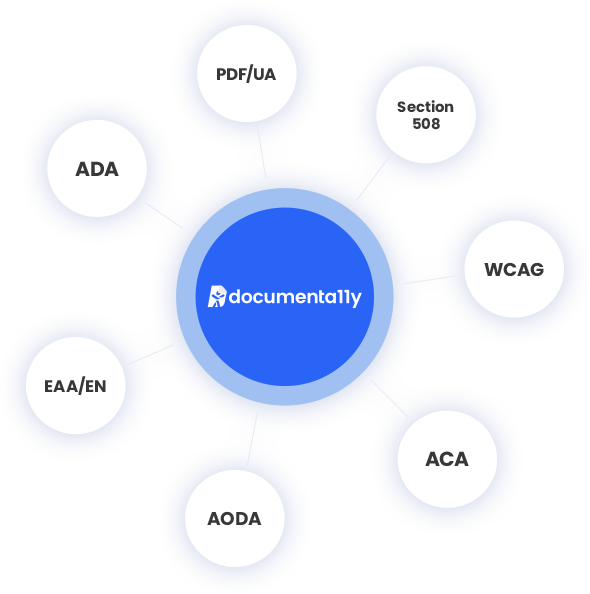
DocumentA11Y.com remediates digital content residing in all forms of documents


We can help you achieve your compliance goals
Our Capabilities


Alt Text for Images

Audio Video Transcription

Closed Captioning

How do we do it?
Frequently Asked Questions
