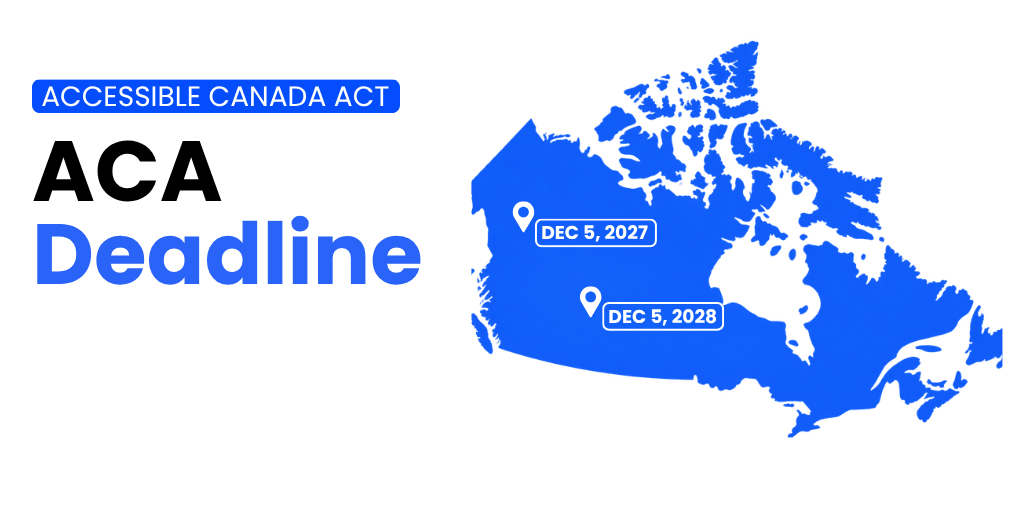
Canadian accessibility planning is running on a countdown. December 5, 2027, and December 5, 2028. Two dates, circled, treated as the moment something arrives.
Nothing arrives. No inspector at reception, no letter, no scan flagging your PDFs. The pressure, though, is real. It just does not work the way most people expect, and that is how organizations end up preparing for the wrong thing.
What does the Accessible Canada Act deadline actually require?
It depends on who you are, but everyone covered must complete staff training by December 5, 2027. After that:
- Public sector organizations need accessible web pages and an accessibility statement by December 5, 2027, then digital documents, mobile apps, procurement checks, and a statement covering them by December 5, 2028.
- Large private organizations (500 or more employees) must cover all of it by December 5, 2028: web pages, digital documents, mobile apps, an accessibility statement, and procurement checks.
- Medium private organizations (100 to 499) need accessible web pages by December 5, 2028. Documents, apps, statements, and procurement checks do not apply to them.
- Small private organizations (99 or fewer) are exempt.
- First Nations Band Councils are temporarily exempt from all requirements until December 31, 2033.
Transportation and broadcasting organizations follow their own rules, covered below. Every requirement is measured against the same standard, CAN/ASC-EN 301 549.
What happens if you miss the deadline?
Not much, on the day itself. The Accessibility Commissioner enforces the Accessible Canada Act through a graduated, risk-based approach that starts with an inspection or a complaint, not a penalty. Most organizations only ever see the first step: a letter with the inspection results and a request to explain how you will fix what it found.
Is the maximum fine $250,000?
No. Every digital obligation in the December 2025 regulations is classified as a minor violation, and the amount then depends on your size and your record. For a federally regulated organization that is not a small business, a first minor violation runs $1,000 to $10,000. It only reaches $75,000 at a fourth or subsequent violation. The $250,000 ceiling applies to a fourth very serious violation. No digital requirement is classified that way. You will see $250,000 and $75,000 quoted often. Neither is your first-offence number.
Your regulator may not be the one you assume
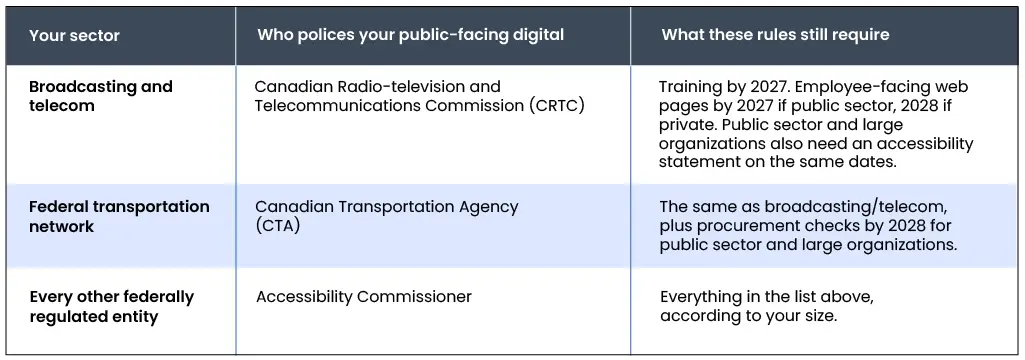
Training is due by December 5, 2027, for all of them.
Is there a grace period for complying with the ACA?
No, nothing in the regulations creates a grace period. What regulators have said is softer than that. Employment and Social Development Canada (ESDC) describes penalties as tools to encourage compliance rather than punish, and enforcement is deliberately graduated. Read that as room to show progress, not room to do nothing. It is how they have said they will behave, not a right you can rely on, and that can change.
Where the real risk sits
- Every day counts separately: If a problem lasts more than one day, each day counts as a separate violation.
- Doing your best is not a defense: Showing that you took reasonable care, or that you believed you were already compliant, will not excuse the violation.
- Leadership is exposed: Officers, directors, and senior officials who ordered it, or knew and let it happen, are on the hook too.
- It can be made public: The commissioner may publish your name, the violation, and the penalty.
What actually exists the day after your deadline
From the day your obligations begin, you are building an evidence record and holding it for four years: training logs, conformity assessments with gap analysis, and your accessibility statement.
That statement is not a badge. It is a public admission of where your web pages, apps, and documents fall short of the standard, along with your plans for closing each gap, refreshed every year.
When enforcement comes, it mostly means an inspector reading back the records you created yourself.
Start with what you will have to show
The Accessible Canada Act’s December 2027 and 2028 obligations do not test your intentions. They test your records, and they raise the bar for what counts as a good one.
If your web pages and PDFs have never been measured against CAN/ASC-EN 301 549, and your deadline falls inside the next twelve to twenty-four months, the gap is worth finding now rather than declaring it later.
You can book a document accessibility audit to see exactly what your accessibility statement will have to admit and fix it while there is still time.
Questions we get asked
Does the Accessible Canada Act apply to my small business?
Not all of it, and the split matters. Federally regulated private businesses averaging 99 or fewer employees do not have to meet any of the digital technology requirements. They may still have to meet the Act’s baseline duties: an accessibility plan, a feedback process, and progress reports. Those start at 10 employees, so only businesses averaging fewer than 10 are clear of both. Businesses averaging 100 to 499 need training by December 5, 2027, and accessible public-facing and employee-facing web pages by December 5, 2028, plus record retention. Digital documents, mobile apps, procurement assessments, and accessibility statements do not apply to them.
Do I need to fix everything by the deadline, or just document what is broken?
Both, and documenting is not a substitute. The rule applies to content you publish or update on or after your date, not to everything already on your site. If something genuinely cannot be made to conform, you are still not off the hook. You provide a temporary alternative until it is fixed and list the gap in your statement.
What happens if I fix a problem after the deadline but before anyone complains?
Nothing in the Act forgives a late fix, but fixing early costs far less. Each day a problem continues counts as its own violation, so correcting it stops the clock. Enforcement starts from a complaint or an inspection, and neither may ever arrive.
Who can file a complaint that triggers an inspection?
Anyone harmed by the breach, whether that is physical or psychological harm, damage to property, or financial loss. They do not have to be your customer. Employees and members of the public can file too.
What is the difference between the ACA and AODA?
The Accessible Canada Act is federal law, and the Accessibility for Ontarians with Disabilities Act (AODA) is Ontario provincial law. Which one applies depends on who regulates your organization, not where it is located. The ACA reaches sectors Ottawa regulates, like banks, airlines, railways, and telecoms. AODA reaches organizations regulated by Ontario.
Is there an ACA fine calculator?
No. What the regulations have instead is a scoring formula, which means the number moves depending on how you handled the problem rather than on which rule you broke. Cooperating with the Accessibility Commissioner pulls the number toward the bottom of its range.
 Accessible Canada Act Deadline: What Happens If You Miss It
 How PDF Remediation Services Handle Complex Layouts
 Can AI Make PDFs Accessible? Detection, Remediation, and Where Humans Still Matter