
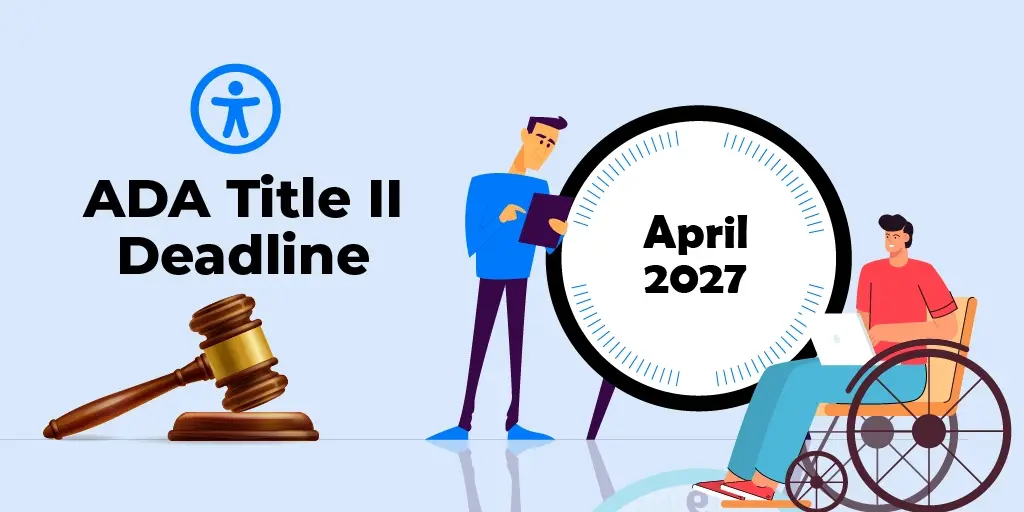
Deadline Extended, but Everything Around It Still Matters
The legal position around ADA Title II remains unchanged, yet the level of concern across the accessibility ecosystem has intensified in recent weeks. With the updated ADA Title II compliance deadline approaching, public entities continue to work toward established expectations for web accessibility and digital accessibility, even as new developments emerge within the regulatory process.
On April 20, 2026, the Department of Justice published an Interim Final Rule officially extending the ADA Title II compliance deadlines by one year, moving the deadline for larger public entities to April 26, 2027, and for smaller public entities and special districts to April 26, 2028.
Public entities must still ensure accessible websites, mobile applications, digital documents, and online services. Any delay in implementation continues to affect millions of individuals who rely on accessible public services.
This blog explores what the current rule requires, what the updated timeline means, and what the ADA Title II compliance deadline means in practice today.
What the Rule Actually Requires
The 2024 rule under ADA Title II did not introduce a new obligation. It clarified and enforced one that has existed for decades. Public entities have long been required to provide equal access. What changed is how that expectation is now defined and measured in digital environments.
The rule applies to state and local governments, including public education institutions, municipalities, and agencies serving civic functions. It sets a clear benchmark for web accessibility and digital accessibility, aligning compliance with WCAG 2.1 Level AA. This is the first time the Department of Justice has formally codified a specific technical standard, removing long-standing ambiguity.
The timeline is also clearly defined. Public entities serving populations of 50,000 or more must comply by April 26, 2027. Public entities serving fewer than 50,000 people, along with special district governments, have until April 26, 2028. These updated timelines are tied directly to the ADA Title II web accessibility compliance requirements and are now driving accessibility planning across public sector organisations.
The scope extends beyond websites. It includes mobile applications, digital documents such as PDFs, and third-party platforms used to deliver public services. Responsibility does not shift with vendors. Accountability remains with the public entity.
A more detailed breakdown of how these requirements apply across institutions is covered in this guide.
The Quiet Disruption: What Is OIRA, What Is an IFR, and What’s Happening with ADA Title II
The standard process for changing a federal rule includes a Notice of Proposed Rulemaking (NPRM), where public input is invited before any decision is finalised. In September 2025, the Department of Justice indicated it was considering this route for ADA Title II, including ways to reduce compliance costs. That step never materialised.
Instead, on February 13, 2026, a notice revealed that the revised rule had been submitted to OIRA, the Office of Information and Regulatory Affairs, for review. Rather than following the usual path, it was submitted as an Interim Final Rule.
An Interim Final Rule allows a regulation to take effect without a prior public comment period. In this case, the revised rule has not been published, and its contents remain unknown. There is no visibility into whether timelines will shift, scope will change, or standards will be adjusted.
What followed made the situation more complex. On March 5, 2026, the National Federation of the Blind formally opposed any changes, stating that the rule had already undergone years of public input and that delaying or weakening it would directly restrict access to essential public services.
At the same time, municipal bodies began pushing in the opposite direction. Organisations such as the National League of Cities and the League of Minnesota Cities started collecting cost data from local governments to argue for flexibility, including phased timelines or reduced scope.
The debate continued to escalate. On March 23, 2026, the Center for Democracy and Technology met with OIRA and argued against clearing the Interim Final Rule, emphasising that any changes should go through a transparent process rather than bypass public input.
On April 20, 2026, the Interim Final Rule (IFR) was published in the Federal Register and took effect immediately, extending the compliance deadlines by one year. The WCAG 2.1 Level AA standard and all other substantive requirements from the 2024 rule remain unchanged. A public comment period remains open until June 22, 2026.
Why This Moment Matters
An inaccessible government website is not a minor inconvenience. For a significant portion of the global population living with disabilities, it can mean being excluded from essential services such as benefits applications, public information, voting processes, legal documentation, and everyday civic participation.
The 2024 rule did not introduce a new responsibility. It formalised an expectation that has existed for decades and made it measurable and enforceable in digital environments.
That is why the current moment carries weight beyond compliance timelines. It directly affects whether public services are accessible in practice, not just in principle. The one-year extension was granted in response to documented readiness challenges, not because the requirement was reconsidered. The Department of Justice made clear that the additional time is intended to support active compliance efforts, not to justify further delay.
What Organizations Must Do Right Now
The April 26, 2027 and April 26, 2028 deadlines are now legally in force under ADA Title II following the Department of Justice Interim Final Rule issued on April 20, 2026. Public entities should continue active compliance efforts, as the one-year extension does not change the underlying requirement to meet WCAG 2.1 Level AA standards for websites, mobile applications, digital documents, and online services.
What leading organisations are doing now:
- Starting with an immediate ADA Title II compliance audit:
Most teams are not relying on automated scans alone. They are pairing them with manual reviews and assistive technology testing, recognising that automation can miss 60 to 70% of accessibility issues. - Focusing on high-impact areas first: Efforts are being directed toward high-traffic pages, core service journeys, and critical public information where accessibility gaps can disrupt access at scale.
- Re-evaluating third-party platforms: There is growing scrutiny of vendor tools and external systems, as accountability for accessibility continues to sit with the public entity, not the provider.
- Addressing document accessibility in parallel: Large volumes of PDFs and digital records are being reviewed, with many organisations investing in ADA pdf accessibility remediation services to manage scale and consistency.
- Building internal documentation and tracking: Teams are formalising remediation plans, assigning ownership, and tracking progress more closely to maintain visibility and accountability.
- Continuing work despite uncertainty: The updated ADA Title II deadlines are now April 26, 2027, and April 26, 2028. Organisations that continue progressing steadily are better positioned than those delaying action, as the underlying compliance requirements remain unchanged and preparation at scale still takes significant time.
In practice, the difference is becoming clear. Some organisations are slowing down in response to uncertainty, while others are using this time to move forward with greater structure and intent.
The Bottom Line
The one-year extension changes the timeline, but it does not change the direction. Public entities now have a valuable opportunity to move from reactive fixes to structured, long-term accessibility planning.
Organisations that use this additional time wisely can reduce remediation pressure, improve user experience, and build stronger internal processes across websites, mobile applications, and digital documents. Those that continue to delay may face larger compliance gaps, higher costs, and greater operational strain as the new deadlines approach.
This is the moment to treat accessibility as an ongoing operational priority rather than a last-minute compliance task. The next year will not simply measure readiness. It will reveal which organisations chose to prepare.
Documenta11y supports this transition through structured ADA Title II compliance audit frameworks and scalable remediation strategies. Start with a clear view of current gaps through comprehensive web accessibility audit services that assess conformance across digital touchpoints and move toward measurable compliance with specialised ADA compliant pdf services.
 How Often Should You Audit Your Website for Accessibility (2026 Guide)
 8 Best Practices for Creating Accessible PDFs in InDesign
 WCAG 3.0 Working Draft: What Accessibility Teams Need to Know