On June 4, a court in Caen gave Carrefour six months to make its grocery site and app fully accessible or pay 500 euros for every day it runs late.
The number the court threw out: 71 percent compliant. Carrefour argued that was good enough. The judge said accessibility is all or nothing.
Now pause here and zoom out. That ruling is the most concrete thing that happened in the European Accessibility Act’s first year. It is not the whole picture.
Today, one year after the deadline, the same law looks like a different law depending on which country you are standing in. Three countries, three answers to one question: What actually happens if you are not compliant? And a court fight inside France that shows even a single country cannot fully agree with itself yet.
How is the EAA enforced across the EU? One law, many interpretations
The short answer: there is no single answer, and that is the whole problem. The EAA set the deadline at June 28, 2025, and set the floor everyone must clear. What it did not do is run blanket enforcement.
Each country built its own machine on top, with its own regulator, its own penalties, its own pace. So “the EAA is enforceable now” is a true statement and almost entirely useless on its own. The real questions are how it is enforced, where, and how hard.
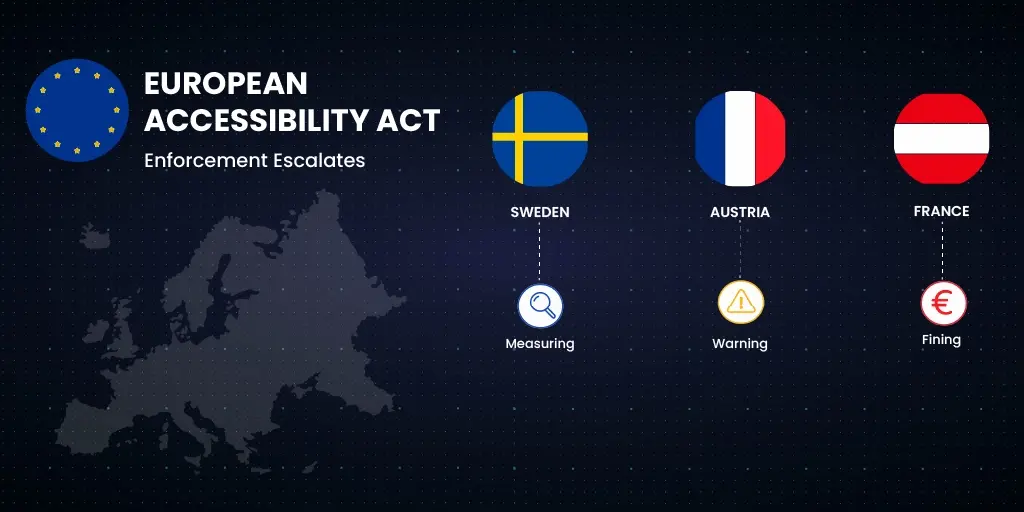
A simple way to hold it in your head: think of the three countries as three levels on the same gauge. Sweden is still measuring. Austria is warning. France is fining. Same directive underneath, three very different experiences of web accessibility compliance depending on your postal code.
What does EAA enforcement look like in Sweden? They’re still taking measurements
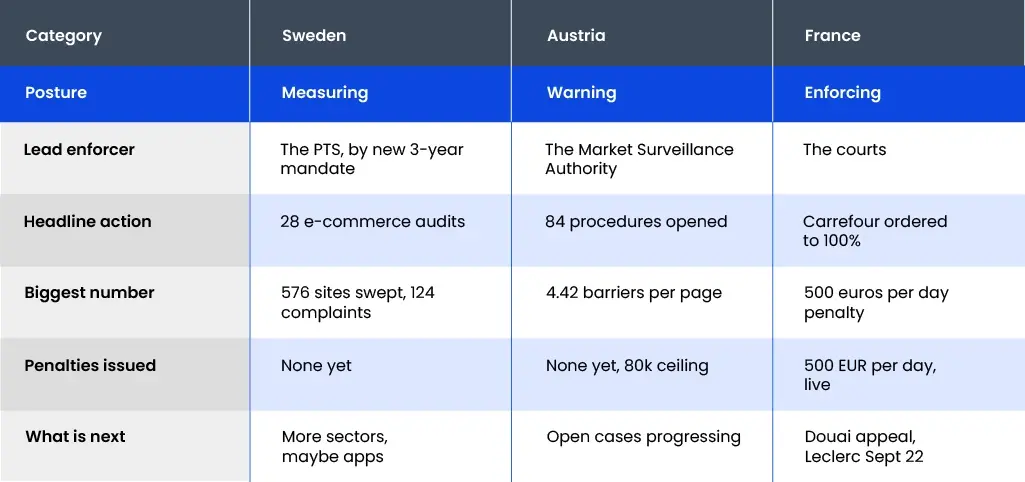
Sweden is what early enforcement looks like when a regulator is mapping the problem before it swings, and the PTS digital inclusion mandate is the clearest signal. The Swedish Post and Telecom Authority (PTS) is one of five authorities enforcing the Swedish version of the law, and it just received a fresh government assignment—published June 9, 2026—to lead digital inclusion across 2026 to 2028.
Here is where Swedish accessibility law enforcement actually stands right now:
It has opened 28 e-commerce supervision cases so far. Names one would recognize are on the list, including Apotea, Åhléns, and Coop.
124 public complaints have come in, 110 about services and 14 about products. About one in five companies drew more than one complaint.
As PTS reported in April, a wide sweep of 576 Swedish sites based on two 2025 measurements found accessibility gaps across all nine sectors tested, and the private sector came out worse than public bodies.
Penalties are possible, from 10,000 up to 10 million kronor. None have been publicly reported as of writing this article.
The read: That oversight is scaling fast, but the stick has not come down. A Sweden e-commerce accessibility audit right now means scrutiny, not sanctions. That will not last forever.
What are the EAA penalties in Austria? These are warning shots
Austria is one step further along the gauge. The machine is live and loaded. The regulator just has not pulled the trigger yet.
Since the Austria digital accessibility law took effect, the Market Surveillance Authority has opened 84 enforcement procedures and reviewed 48 tips, according to figures from the Social Ministry marking the law’s first year. Banking is where the pressure concentrates: of the 53 non-conformities that companies have self-reported so far, most came from the banking, finance, and insurance sectors.
One striking number anchors the whole picture. Austrian sites average 4.42 accessibility barriers per page, and just 1 in 50 is fully accessible.
No fines so far, and that is a choice. The authority is leading with consultation before penalty. But the penalty ceilings waiting behind that patience are real: up to 80,000 euros for large firms, 50,000 for SMEs, and 25,000 for micro-enterprises. So the question of Austria web accessibility fines is not whether the law allows them. It is when the regulator decides to use them.
The read: Enforcement is real and staffed. The penalty phase is a decision away, not a law away.
What was the Carrefour accessibility lawsuit ruling? France showed the first real bite
France is what it looks like when you run out of second chances. The warning is over. Let’s go back to Carrefour, now with the full picture.
In the Carrefour accessibility ruling in Caen on June 4, the court ordered Carrefour France to make carrefour.fr and its app fully accessible within six months, or pay 500 euros every day after that.
The principle the court leaned on leaves zero wiggle room and takes no excuses. Accessibility is an obligation of result: either the site clears 100 percent of the applicable criteria, or it does not comply. “A little accessible” is not a category the law recognizes.
In fairness to Carrefour, here is its side. The company says 71 percent is double where it stood three years ago, that daily site updates make full compliance hard to hold, and that it is reviewing the ruling and may appeal. It says it aims for 100 percent by the end of 2026.
The read: This month, a French court attached a live, ticking financial penalty to inaccessibility. Not a hypothetical. A meter running, tallying a cost adding up by the day. And France is the only country to have done this so far. For anyone tracking French accessibility law compliance in 2026, this is the moment the theory became a number.
The split inside France should worry everyone: Auchan vs Carrefour
But here is the twist that undoes everything we talked about. France cannot fully agree with France.
In Lille, on May 5, one month before Caen, the same advocacy groups brought a near-identical case against Auchan’s online arm. And they lost.
Why the opposite result? A clash between two French laws. The consumer code, which transposed the EU directive, pulls in any e-commerce business over 2 million euros in revenue. An older 2005 law sets a much higher bar, at 250 million. Lille ruled that the older, higher threshold wins. Auchan’s e-commerce subsidiary booked only 144 million in 2024, so the court said the law simply did not reach it.
Now the part that should make every team’s compliance lead sit up. Auchan’s site was at 41 percent in February, worse than Carrefour’s 71. The company in worse shape walked. The one doing better got fined. The difference was a corporate structure, not a screen reader.
Same question, two courts, one month apart, two opposite answers on who the law even applies to.
The Auchan ruling is now under appeal at Douai. And the story is not finished: E. Leclerc is heard September 22 in Créteil, and Picard is not yet scheduled.
What enforcement of the European Accessibility Act (EAA) looks like in Sweden, Austria, and France
What does EAA enforcement mean if you operate in the EU?
Time to turn the news into something you can act on. If you sell to EU consumers, here is the honest takeaway.
“EAA compliant” is not one bar. It is at least 27 enforcement regimes sitting on top of one directive, and they are not moving in sync. That is a genuine planning problem, because the EAA e-commerce compliance requirements you are measured against in practice depend on which exact regulator and which court, looks at you first.
But they are all moving in one direction. Measuring becomes warning becomes fining. France just proved the last step is not hypothetical, and the regulators behind these talk to each other. What is settled in one country tends to travel.
The trap to avoid is reading “untested in my country” as “safe in my country.” The Caen ruling did not exist two months ago either. This is the same uneven, country-by-country pattern we traced in our look at digital accessibility after the EAA deadline, where the gaps were already showing.
There is a second layer coming, too. As AI gets embedded into checkout, support, and core user journeys, accessibility obligations start to overlap with new rules, something we unpack in our piece on the EU AI Act and accessibility. The compliance picture is widening, not narrowing.
Every one of these cases pivots on the same gap: between what a company assumes about itself (“we are mostly accessible”) and what a trained tester actually finds. Carrefour believed 71 percent was fine. A court disagreed. This is where a real accessibility audit earns its keep. A proper WCAG compliance review catches the failures a self-assessment or an automated scan quietly misses—the keyboard traps, the unlabeled forms, the flows that fall apart under a screen reader—before a regulator or an advocacy group finds them for you.
This is the work Documenta11y does. Our team runs manual, expert-led web accessibility audit services against EN 301 549 and WCAG, then hands your developers a clear, prioritized path to fixing what we find, not just a list of problems to stare at. If your products, services, or documents touch the EU market at all, we can tell you where you actually stand and what it will take to close the gap before the question gets decided for you in a courtroom.
Talk to Documenta11y about a scoped, expert accessibility audit, and have our EAA compliance services team explain to you exactly where you stand.
Conclusion
A year ago, the EAA was a date on a calendar. Now it is a question every regulator and every court is answering differently.
The direction of travel is the only thing they all agree on. Measuring hardens into warning; warning sharpens into fining. The countries still measuring today are closely watching the ones already writing daily penalties. The uneven part is temporary. The trend is not.
Frequently Asked Questions
What happens if you don’t comply with the EAA?
It depends on the country, but the direction is consistent. Enforcement ranges from monitoring and complaint reviews in Sweden, to opened procedures and pre-fine consultation in Austria, to live court-ordered penalties in France, where Carrefour currently faces 500 euros per day. Fines can be steep, up to 80,000 euros per breach in Austria and up to 10 million kronor in Sweden. The safest assumption is that a compliance gap is now an active liability, not a future one.
Are there standard European Accessibility Act fines by country yet?
Austria and Sweden have not issued fines so far; both are leading with consultation and oversight first. France is the outlier: a Caen court has already attached a 500-euros-per-day penalty to Carrefour if it does not reach full accessibility within six months.
Why did Carrefour get fined but Auchan did not?
Because two French courts read two different laws. In the Auchan vs Carrefour accessibility case, Lille ruled that an older 2005 law with a 250-million-euro revenue threshold applied, and Auchan’s e-commerce arm, at 144 million in 2024, fell below it. Caen applied the consumer code’s 2-million threshold and found Carrefour covered. The Auchan decision is under appeal, so this contradiction is not settled.
Does the EAA apply to my business if I am outside the EU?
If you sell products or services to any consumers in the EU through a website or app, absolutely any at all, assume you are in scope until you confirm otherwise. The EAA covers e-commerce, banking, telecoms, transport, e-books and more, regardless of where your company is headquartered. There is limited relief for the smallest micro-enterprises providing services, but most online businesses fall under these laws.
How do I know if my website is actually EAA compliant?
Self-assessment is where most organizations go wrong; Carrefour believed 71 percent was enough. The reliable route is a manual, expert-led accessibility audit against EN 301 549 and WCAG, which catches the screen-reader failures, keyboard traps and unlabeled elements that automated scans miss. It should end with a prioritized remediation plan your developers can act on, not just a list of problems.
Can Documenta11y help my business comply with the EAA?
Yes. Documenta11y runs manual, expert-led accessibility audits against EN 301 549 and WCAG, the standards the EAA is enforced through, and then gives your team a prioritized roadmap to fix what’s found. Whether you are a retailer, a bank, or an e-commerce business selling into the EU, we can show you exactly where you stand before a regulator or a court does.
Don’t wait for a complaint to find out where you stand. Talk to Documenta11y about a scoped EAA compliance audit, and know exactly what the law requires of your site and how to get there.
 How Often Should You Audit Your Website for Accessibility (2026 Guide)
 8 Best Practices for Creating Accessible PDFs in InDesign
 WCAG 3.0 Working Draft: What Accessibility Teams Need to Know