Client Profile
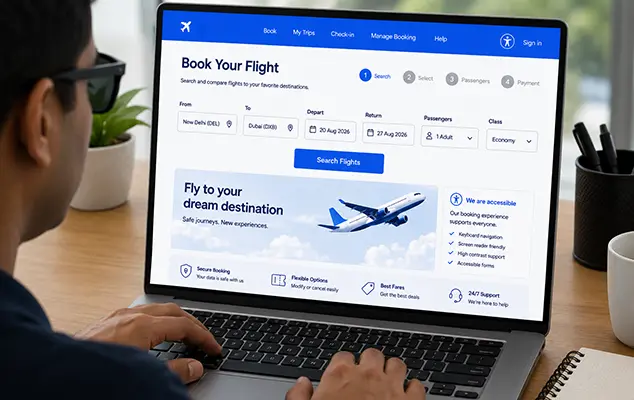
The client is a leading international airline operating across more than 100 domestic and international destinations and serving over 60 million passengers annually. Like most airlines, a large part of the customer experience happens online. Passengers search for flights, compare options, complete bookings, check in, select seats, and manage their trips through digital channels. The client wanted to understand how well these experiences worked for travelers with disabilities and whether any accessibility barriers were making essential tasks harder to complete independently.
Challenges
The airline wanted to ensure that its digital services could be used independently by all travelers, including people with disabilities. With passengers relying on the website and booking platforms to search for flights, complete reservations, check in, manage trips, and access customer services, accessibility had become an important part of the overall travel experience.
The organization needed a clear understanding of how accessible these critical customer journeys were and where improvements were required. It also wanted a structured assessment against WCAG requirements that would help prioritize accessibility issues based on their impact on users and provide a practical roadmap for remediation.
Our Approach
The engagement began with a comprehensive WCAG accessibility audit of the airline’s customer-facing digital platforms. The assessment focused on the journeys passengers use most, including flight search, booking, online check-in, trip management, payment, and customer support, to understand how accessible these services were for people with disabilities.
The evaluation combined detailed manual testing with assistive technology testing, including testing by screen reader users, to identify accessibility barriers that could affect real-world use. Keyboard navigation, screen reader compatibility, forms, interactive components, dynamic content, images, color contrast, and focus indicators were all evaluated against WCAG requirements.
Accessibility findings were documented and classified by severity, giving the airline a clear view of the issues with the greatest impact on users. Each finding included developer-ready remediation recommendations to help development teams address problems efficiently without additional interpretation.
The findings were then prioritized based on user impact and business criticality, creating a structured remediation roadmap that enabled the airline to address high-priority issues first while establishing a clear path toward improving accessibility across its digital services.
The Impact
- Established a clear understanding of accessibility gaps across critical customer journeys.
- Improved WCAG compliance readiness through a comprehensive accessibility assessment.
- Accessibility findings categorized by severity to support informed decision-making.
- Prioritized remediation roadmap based on user impact and business criticality.
- Developer-ready recommendations that enabled faster issue resolution planning.
- A structured foundation for ongoing accessibility improvements across customer-facing digital services.
The structured assessment and prioritized remediation roadmap enabled the organization to focus on the issues with the greatest impact on both users and business operations.
As a result, the airline strengthened its accessibility compliance readiness, improved usability across critical digital services, and advanced its commitment to providing a more inclusive travel experience for all passengers.