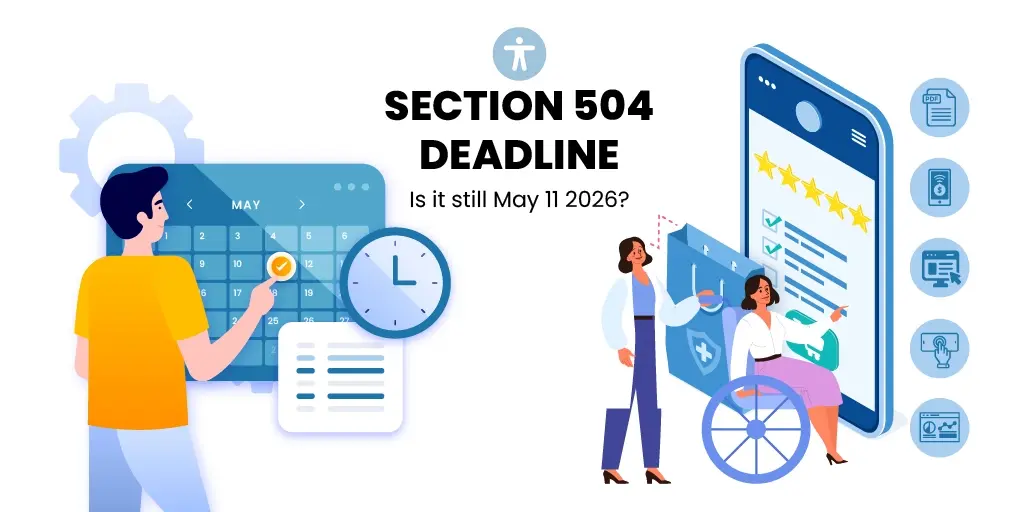
UPDATE — May 7, 2026: HHS has officially extended its Section 504 accessibility deadline by one year. HHS’ Office for Civil Rights confirmed the Interim Final Rule the day after our original article was published. Under the updated deadlines:
- Recipients with 15+ employees now have until May 11, 2027, to comply.
- Recipients with fewer than 15 employees now have until May 10, 2028.
The underlying requirements for WCAG 2.1 AA compliance remain unchanged. OCR Director Paula M. Stannard has stated the extension was made to provide “necessary flexibility” while allowing time for aligning Section 504 timelines with the DOJ’s parallel Title II rulemaking.
What this means for you: The IFR landed exactly where our signals predicted: same playbook as the DOJ, same one-year extension, same OIRA route. The obligation didn’t disappear; rather, it just got its new date. The action plan in the article below still stands. Organizations and institutions that use this extra year wisely will have a fundamental advantage by May 2027 over those that wait.
Our original article continues below for context.
Less than two weeks ago, all eyes were on the Department of Justice (DOJ). On April 20 of this year, it announced a major deadline extension for ADA Title II compliance, literally a mere four days before it was set to knock at the door with consequences in tow. We all remember the headlines and panic that surrounded that race to the finish line. Now, they had a full year. Everyone who held their breath finally relaxed.
It was the iceberg that we didn’t hit. But another ruling entirely still poses a ticking threat, and Health and Human Services (HHS) might not do the same thing and blink first. This second deadline is still binding, this time from the HHS, and every hospital, clinic, and HHS-funded organization is in the crosshairs.
The HHS Section 504 digital accessibility deadline of May 11, 2026 is barreling towards us, and the new question on everyone’s minds is a stressful one: Is HHS going to blink first?
Assumptions Amiss
April 20th’s announcement from the DOJ came with an important warning: It will lull even those who are alert until now. People assumed HHS would follow suit, of course. After all, how could they not? Everyone will have more time, so it’s best to wait and see. That was the logic, the assumption, and the danger.
DOJ and HHS are NOT the same.
Both are completely separate offices with completely separate modes of operation. The DOJ ADA Title II extension decision does not in any way automatically bind the HHS. And as of today, this fundamental distinction means May 11 is still HHS’s Section 504 deadline.
While there is overlap in objectives and formats for both agencies to roll out compliance initiatives, the target audiences for these are different in reality. The DOJ’s extension covers state and local governments under ADA Title II. HHS Section 504 covers hospitals, clinics, insurers, universities—basically any entity that receives HHS funding.
Both had shared technical thresholds to cross, but not for legal implementation calendars.
Different ruling. Different agency. Different clock.
The HHS Hasn’t Budged
Even so, only the countdown has moved back even for the DOJ. The same underlying WCAG 2.1 AA compliance requirements and technical guidelines remained unchanged for Title II. The department pushed rules for larger entities back by a whole year to April 26, 2027. The HHS’s deadline, however, still looms over any funded organizations with 15+ employees.
This agency hasn’t budged, and no official Section 504 extension has been announced yet. But the signals are stronger than ever.
Word On The Street
“Is HHS Going to Issue a Similar IFR?”
For extending Title II mandates, filing an Interim Final Rule (IFR) routed through the Office of Information and Regulatory Affairs (OIRA) would mean bypassing the public notice-and-comment process otherwise mandated by the Administrative Procedure Act (APA). But the DOJ did exactly this three weeks ago.
Critically, HHS so far has played by the exact same playbook. On April 17, 2026, their Office for Civil Rights (HHS OCR) quietly submitted an interim final rule to OIRA pertaining to Section 504, and its contents and details weren’t made public; we only know it exists when it showed up on the regulatory agenda. As of writing this article, this IFR is listed as pending.
The American Council for the Blind also warns of this ambiguity and reminds us that while the current compliance deadline could be delayed and the details not clear, the current schedule is still worth knowing and preparing for. These are May 11, 2026, for HHS funding recipient teams of 15 people or more and a year later on May 10, 2027, for those of smaller recipient groups.
Many are anticipating the current compliance deadline for web content, mobile app accessibility, and more to be extended, but especially until an official announcement is made, those whose job it is to adapt and respond quickly to any updates are currently left in limbo for answers. Whether you are “cautiously optimistic” or frantically drawing plans to scale your PDF accessibility efforts right away, it’s time to keep track of any communication from the HHS regarding this.
What We Can Do
Whether an extension is granted or not, the hospitals, clinics, insurers, and universities this touches that use this window wisely will be ahead and better equipped one year from now. Here are just a few things to get started:
- Public-facing sites and content first: Patient portals, appointment booking pages, telehealth entry points. A thorough website accessibility audit of your public-facing content will triage what fixes are a priority. Web-based or not, these are most likely what patients—and frankly, the HHS OCR—will encounter first.
- Fix high-impact high-traffic PDFs next: Patient consent forms, intake documents, and discharge summaries. Go through any documents and forms touched frequently.
- Build a remediation plan: Have a written plan to lay out and track the status of your progress. What’s already been audited, what’s in remediation, and your timeline. WCAG 2.1 AA compliance for healthcare organizations is an ongoing commitment, not a one-time fix, and a written plan demonstrates good faith to the OCR when they come knocking and reduces litigation exposure.
Their playbook is familiar, and patterns suggest one way. However, a pending HHS IFR is not a published rule and can change course in an instant.
Whatever HHS decides, the very people these healthcare requirements were made to help are listening. The obligation doesn’t disappear or resolve with this suspense; it just waits for a date. We just don’t know which one.
 EU AI Act and Accessibility: What Organizations Need to Know
 How a Templatized Approach Scales PDF Remediation
  GAAD 2026: Fifteen Years Later, Is the Digital World More Accessible?